
Business News
Libyan High Council of State Members Announce Support for Restoration of Constitutional Monarchy
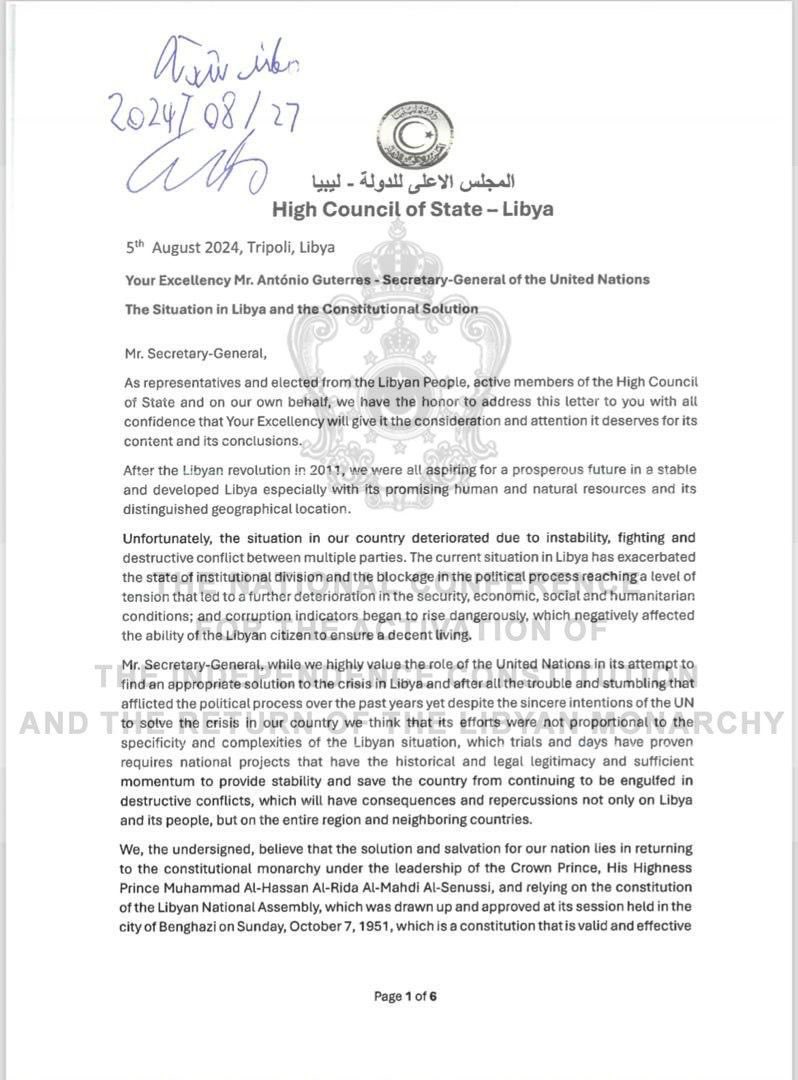
Letter sent to UN Secretary General António Guterres
LONDON, UNITED KINGDOM , September 2, 2024 /EINPresswire.com/ — On August 5th, 2024, 75 out of 145 members of the High Council of State of Libya formally expressed their support for the restoration of Libyaâs historic parliamentary democracy under the leadership of a constitutional monarchy led by His Royal Highness Prince Mohammed al-Rida al-Senussi, Crown Prince of Libya, in a letter addressed to UN Secretary-General António Guterres which was made public on August 31st. This significant political development signals growing momentum towards reestablishing Libya's constitutional monarchy as a pathway to resolving the nation's protracted conflict and institutional divisions.
The signatories, representing the diverse regions of western, eastern, and southern Libya, called for a return to the 1951 constitution of the Libyan National Assembly. This constitution, drafted and approved on October 7, 1951, in Benghazi, is seen as the sole unifying legal framework capable of reconciling Libya's fractured political landscape. They emphasised that this constitution remains "valid and effective to this day" and could serve as "the only unifying matter that all the conflicting factions in Libya will agree upon."
The members of the High Council of State also expressed their support for the initiative of the Crown Prince, praising his efforts to foster national unity through extensive consultations which have taken place over recent months. In their letter, they highlighted that the state of institutional division in Libya has reached a critical point, leading to deteriorating security, economic, social, and humanitarian conditions, with a marked rise in corruption that threatens the ability of the Libyan people to maintain a decent quality of life.
Background on the High Council of State of Libya
The High Council of State is a consultative body established in 2015 as part of the Libyan Political Agreement (LPA), an initiative aimed at ending the civil conflict that erupted following the ousting of Muammar Gaddafi in 2011. The Council is composed of 145 members representing different regions and political factions, playing a key role in advising and guiding Libya's political process, including the formation of national unity governments and efforts to draft a permanent constitution.
Despite numerous attempts at mediation by international organizations, including the UN, the Libyan crisis has continued to escalate. Since the fall of Gaddafi, Libya has been plagued by civil war, competing governments, and a collapse of state institutions, leading to significant regional and tribal divisions, armed conflicts, and a complex web of local and international interests.
Efforts to broker peace and stability, including multiple ceasefires and attempts at political reconciliation, have largely failed to create a sustainable solution. The inability to establish a unified government and functioning political system has perpetuated instability, leaving the country's security and economy in disarray.
The Call for Constitutional Monarchy as a Solution
The recent initiative by members of the High Council of State to support the restoration of the constitutional monarchy represents a turning point. This move is seen as a response to the ongoing institutional divisions and the failure of past initiatives to bring about a comprehensive resolution to the Libyan conflict. The letter to the UN Secretary-General underscores the urgency of a new approach that relies on Libya's historical constitutional framework and the leadership of the Senussi royal family.
The members of the High Council of State believe that restoring the constitutional monarchy offers a legal and constitutional basis for a return to a democratic state that embraces all Libyans, ensuring fair and transparent elections for a national parliament and providing a unifying direction for the country's future.
Quotes from the Letter to the United Nations Secretary-General
In their letter, the members stated:
"We demand reliance on the constitution of the Libyan National Assembly that it drafted and approved in its session held in the city of Benghazi on Sunday, October 7, 1951, which is a constitution that is valid and effective to this day, considering that this is the only unifying matter that all the conflicting factions in Libya will agree upon."
They further praised the efforts of His Royal Highness Prince Mohammed al-Rida al-Senussi, noting:
"The state of institutional division has worsened, and the political process has reached a level of tension that has led to the deterioration of the security, economic, social, and humanitarian conditions, as corruption indicators have witnessed a dangerous rise, which has negatively affected the ability of the Libyan citizen to ensure a decent life."
The members expressed their undivided support for Prince Mohammed al-Rida al-Senussi and his recent consultations:
"We support His Royal Highness Prince Mohammed al-Rida al-Senussi and his consultations that he conducted during the past months, of which we were a part, and which aim to unite the word and unify visions around the principle of returning to the constitutional royal legitimacy as a legal and constitutional umbrella for returning to a democratic state that embraces all Libyan men and women and guarantees their right to elect their representatives in a national parliament through fair and transparent elections."
Ashraf Boudouara
Conference for Activation of the Independence Constitution
boudouara@hotmail.com
Legal Disclaimer:
EIN Presswire provides this news content “as is” without warranty of any kind. We do not accept any responsibility or liability
for the accuracy, content, images, videos, licenses, completeness, legality, or reliability of the information contained in this
article. If you have any complaints or copyright issues related to this article, kindly contact the author above.


Letter sent to UN Secretary General António Guterres
LONDON, UNITED KINGDOM , September 2, 2024 /EINPresswire.com/ — On August 5th, 2024, 75 out of 145 members of the High Council of State of Libya formally expressed their support for the restoration of Libyaâs historic parliamentary democracy under the leadership of a constitutional monarchy led by His Royal Highness Prince Mohammed al-Rida al-Senussi, Crown Prince of Libya, in a letter addressed to UN Secretary-General António Guterres which was made public on August 31st. This significant political development signals growing momentum towards reestablishing Libya’s constitutional monarchy as a pathway to resolving the nation’s protracted conflict and institutional divisions.
Subscribe to URBT News
The signatories, representing the diverse regions of western, eastern, and southern Libya, called for a return to the 1951 constitution of the Libyan National Assembly. This constitution, drafted and approved on October 7, 1951, in Benghazi, is seen as the sole unifying legal framework capable of reconciling Libya’s fractured political landscape. They emphasised that this constitution remains “valid and effective to this day” and could serve as “the only unifying matter that all the conflicting factions in Libya will agree upon.”
The members of the High Council of State also expressed their support for the initiative of the Crown Prince, praising his efforts to foster national unity through extensive consultations which have taken place over recent months. In their letter, they highlighted that the state of institutional division in Libya has reached a critical point, leading to deteriorating security, economic, social, and humanitarian conditions, with a marked rise in corruption that threatens the ability of the Libyan people to maintain a decent quality of life.
Background on the High Council of State of Libya
The High Council of State is a consultative body established in 2015 as part of the Libyan Political Agreement (LPA), an initiative aimed at ending the civil conflict that erupted following the ousting of Muammar Gaddafi in 2011. The Council is composed of 145 members representing different regions and political factions, playing a key role in advising and guiding Libya’s political process, including the formation of national unity governments and efforts to draft a permanent constitution.
Libyan High Council of State Members Announce Support for Restoration of Constitutional Monarchy
Despite numerous attempts at mediation by international organizations, including the UN, the Libyan crisis has continued to escalate. Since the fall of Gaddafi, Libya has been plagued by civil war, competing governments, and a collapse of state institutions, leading to significant regional and tribal divisions, armed conflicts, and a complex web of local and international interests.
Efforts to broker peace and stability, including multiple ceasefires and attempts at political reconciliation, have largely failed to create a sustainable solution. The inability to establish a unified government and functioning political system has perpetuated instability, leaving the country’s security and economy in disarray.
The Call for Constitutional Monarchy as a Solution
The recent initiative by members of the High Council of State to support the restoration of the constitutional monarchy represents a turning point. This move is seen as a response to the ongoing institutional divisions and the failure of past initiatives to bring about a comprehensive resolution to the Libyan conflict. The letter to the UN Secretary-General underscores the urgency of a new approach that relies on Libya’s historical constitutional framework and the leadership of the Senussi royal family.
The members of the High Council of State believe that restoring the constitutional monarchy offers a legal and constitutional basis for a return to a democratic state that embraces all Libyans, ensuring fair and transparent elections for a national parliament and providing a unifying direction for the country’s future.
Quotes from the Letter to the United Nations Secretary-General
In their letter, the members stated:
“We demand reliance on the constitution of the Libyan National Assembly that it drafted and approved in its session held in the city of Benghazi on Sunday, October 7, 1951, which is a constitution that is valid and effective to this day, considering that this is the only unifying matter that all the conflicting factions in Libya will agree upon.”
They further praised the efforts of His Royal Highness Prince Mohammed al-Rida al-Senussi, noting:
“The state of institutional division has worsened, and the political process has reached a level of tension that has led to the deterioration of the security, economic, social, and humanitarian conditions, as corruption indicators have witnessed a dangerous rise, which has negatively affected the ability of the Libyan citizen to ensure a decent life.”
The members expressed their undivided support for Prince Mohammed al-Rida al-Senussi and his recent consultations:
“We support His Royal Highness Prince Mohammed al-Rida al-Senussi and his consultations that he conducted during the past months, of which we were a part, and which aim to unite the word and unify visions around the principle of returning to the constitutional royal legitimacy as a legal and constitutional umbrella for returning to a democratic state that embraces all Libyan men and women and guarantees their right to elect their representatives in a national parliament through fair and transparent elections.”
Ashraf Boudouara
Conference for Activation of the Independence Constitution
boudouara@hotmail.com
Libyan High Council of State Members Announce Support for Restoration of Constitutional Monarchy
Legal Disclaimer:
EIN Presswire provides this news content “as is” without warranty of any kind. We do not accept any responsibility or liability for the accuracy, content, images, videos, licenses, completeness, legality, or reliability of the information contained in this article. If you have any complaints or copyright issues related to this article, kindly contact the author above.